You've walked into a room before and felt it — that person who commands attention before saying a word. No loud entrance, no big gesture. Just the way they carry themselves. That's not personality. That's physiology.
The connection between posture and confidence is no longer a soft theory. It's backed by hard data from Harvard, Auckland University, and multiple peer-reviewed journals. And it affects you in two directions: how other people read you, and how you actually feel inside.
What People See Before You Speak
Research in social psychology consistently shows that first impressions form in under 7 seconds — and the vast majority of that judgment is non-verbal. Your posture is one of the loudest signals in the room.
A 2011 study published in Psychological Science found that body language cues related to posture and expansiveness were rated as among the most powerful predictors of perceived confidence and competence. People in upright, open postures were consistently judged as more authoritative, trustworthy, and capable — before speaking a single word.
In business meetings, pitch rooms, and job interviews, you are being assessed constantly. The person across the table is making unconscious judgments about your competence based on how you sit, how you stand, and how you hold your head. Upright posture signals control. Collapsed posture signals defeat — regardless of what you're actually saying.
"Adopting expansive, upright postures not only affects how others perceive individuals, but also influences the individuals' own self-perception and risk tolerance."
— Carney, Cuddy & Yap, Psychological Science (2010)What It Does to You on the Inside
Here's where it gets more interesting. The posture–confidence link isn't just about appearances. It's hormonal.
Harvard psychologist Amy Cuddy and her colleagues conducted a landmark study showing that holding an upright posture for just 2 minutes produced measurable hormonal changes in participants:
The reverse was equally true: collapsed, hunched postures produced the opposite hormonal shift — higher cortisol, lower testosterone — driven entirely by physical position, not by thought, mood, or circumstance.
A 2017 study by Wilkes et al. from the University of Auckland confirmed this further. Participants who maintained upright posture during a stressful task reported significantly higher self-esteem, more positive mood, lower fatigue, and lower fear compared to those who sat slouched — identical situations, opposite physical positions, measurably different outcomes.
The Hidden Cost Nobody Calculates
The average person spends 8–10 hours a day sitting. Most of that time is spent in a progressively collapsed position as fatigue sets in. Every hour in that contracted state isn't neutral — it's actively reinforcing a neurological baseline of low confidence.
Your body's proprioceptive system sends thousands of positional signals to your brain every single day. Collapsed posture is interpreted as defeat. Upright posture is interpreted as control. Repeat either long enough, and your nervous system accepts it as the default. This is why poor posture doesn't just affect one meeting — it shapes your entire internal state across the day.
The people most affected are typically the most ambitious: high-performing professionals and entrepreneurs who invest heavily in skills, preparation, and communication — without ever realizing their body is quietly undermining every room they walk into.
"Most people are not lacking confidence. They are lacking the physical foundation that allows their confidence to be expressed."
— The Silent Confidence Killer, Korevo Research GuideThe Wider Benefits of Better Posture
Confidence and presence are the headline. But correcting your posture triggers a cascade of benefits that affect your performance and health across the board:
So What Do You Do About It?
This is where most people hit a wall. They know posture matters. They just don't know how to actually fix it in a way that sticks.
The instinct is to "try harder" — remind yourself to sit up straight, roll your shoulders back. This works for about 90 seconds before you forget and collapse again. Willpower is not the answer to a habit problem.
The three common solutions each come with significant friction:
| Solution | Does it work? | The problem |
|---|---|---|
| Physiotherapy | Yes, eventually | €60–€120 per session. Requires months of repeated appointments. Results depend on compliance between sessions. |
| Exercise & stretching | Partially | Requires a trainer, a structured program, consistent effort over months. Most people don't stick with it. |
| Passive braces / supports | Short-term only | Deactivates postural muscles. Creates dependency. Alignment returns to baseline (or worse) the moment you remove it. |
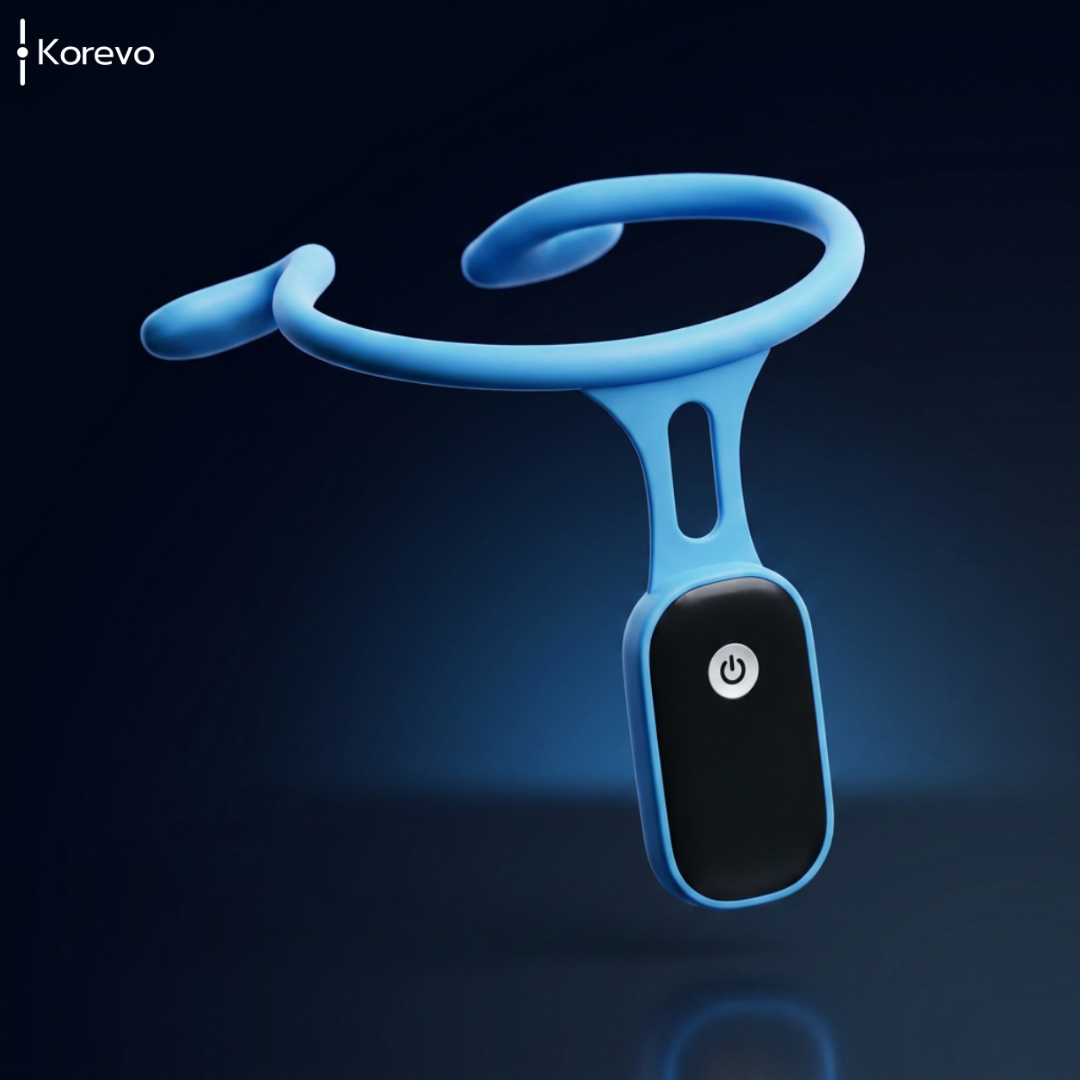
| Korevo Smart Alignment Device | Yes — actively | One-time purchase. Real-time feedback trains your muscles to hold alignment independently. Results felt within days. |
The key distinction is active vs. passive correction. Motor learning research is clear: lasting postural change requires real-time feedback and repeated active muscle engagement — not being held in place by a device that does the work for you.
The Korevo Smart Alignment Device works by detecting postural drift the moment it happens and signaling your body to correct itself. Your muscles respond. Your nervous system registers the correction. Repeat this hundreds of times a day, and after approximately 21 days, your body establishes the upright position as its new neurological default — without the device.
That's not a claim. That's how motor learning works.
The Smarter Fix
One device. One investment.
A permanent change.
Physio costs hundreds per month. A trainer costs more. The Korevo Smart Alignment Device is a one-time purchase that trains your posture — and your confidence — to hold itself permanently.
The solution is right below
Free shipping · 30-day money-back guarantee
Sources: Carney, Cuddy & Yap (2010), Psychological Science; Wilkes et al. (2017), Journal of Behavior Therapy and Experimental Psychiatry; Cuddy et al. (2015), Journal of Applied Psychology; Nair et al. (2015), Health Psychology; Mehrabian & Ferris (1967), Journal of Consulting Psychology.